
Open Bank Account in Japan as a Foreigner: Complete 2026 Guide
Open Bank Account in Japan as a Foreigner: Complete 2026 Guide
Opening a bank account in Japan as a foreigner is one of the first things you need to do after arriving — yet it remains one of the most confusing steps. This complete 2026 guide explains exactly which documents you need, which banks accept foreign nationals, and how to get your account open as quickly as possible.
Table of Contents
- Why You Need a Japanese Bank Account
- Requirements to Open a Bank Account in Japan as a Foreigner
- Best Banks for Foreigners in Japan 2026
- Step-by-Step Guide to Opening Your Account
- Common Problems and How to Solve Them
- After Opening Your Account: Essential Next Steps
- Frequently Asked Questions
Why You Need a Japanese Bank Account {#why-you-need}
If you have just arrived in Japan on a work visa, student visa, or spouse visa, a domestic bank account is not optional — it is essential. Cash-only living in Japan is increasingly difficult, and many essential services require a Japanese bank account for automated billing.
For Salary Payments
Japanese employers almost universally pay salaries via domestic bank transfer (振込, furikomi). Most HR departments will not cut a check or pay into a foreign account. Without a Japanese bank account, you simply cannot receive your salary. This is true for full-time employees, part-time workers, and even scholarship recipients at universities. Setting up your account before your first paycheck date should be your top priority.
For Utilities and Monthly Bills
Electricity, gas, water, and internet providers in Japan bill via automatic bank debit (口座振替, kōza furikae). While some allow convenience store payment, automatic debit is the default and often required when signing a lease. Your landlord or real estate agent will almost certainly request bank account details when you move in.
For Daily Cashless Payments
Japan is rapidly shifting to cashless payments. IC cards like Suica and PASMO, QR payment apps like PayPay, and credit cards are all commonly linked to a Japanese bank account for top-ups and repayment. Having a local account makes managing everyday spending dramatically easier.
Requirements to Open a Bank Account in Japan as a Foreigner {#requirements}
The exact requirements vary by bank, but the core criteria are consistent across all major institutions.
Residence Card (在留カード) — What You Need to Know
Your Residence Card (在留カード, Zairyu Card) is the single most important document. It is issued by immigration at the airport when you arrive on a mid-to-long-term visa (work, student, spouse, etc.). Banks use it to verify your legal residency status, your address, and the validity of your stay in Japan.
Make sure your Residence Card displays your current address. If you have moved since receiving it, update the address at your local city hall first — banks will reject a card showing an old or blank address field.
Required Documents Checklist
Most banks require the following:
| Document | Notes |
|---|---|
| Residence Card (在留カード) | Must show current address |
| Passport | Original, not a copy |
| My Number Card (マイナンバーカード) | Required by some banks as a second ID |
| Personal seal (印鑑) or signature | Branch-based banks typically require a seal |
| Japanese phone number | For SMS verification and account alerts |
| Initial deposit cash | Usually ¥1,000–¥10,000 depending on the bank |
Online banks like Rakuten Bank and Sony Bank typically require only your Residence Card, passport, and a selfie photo for identity verification — no in-person visit needed.
The 6-Month Rule: Fact vs. Myth
You may have heard that you need to have been living in Japan for at least 6 months before you can open a bank account. This is largely a myth in 2026. The rule originated from older anti-money-laundering policies that some branches applied informally. While a handful of major bank branches still apply informal waiting periods, Japan Post Bank, Rakuten Bank, and Sony Bank accept new arrivals with no minimum residency period, as long as you hold a valid Residence Card with a registered address.
If a bank counter refuses you on this basis, politely ask for the specific regulation in writing — many staff are enforcing an outdated internal practice, not an actual legal requirement.
Best Banks for Foreigners in Japan 2026 {#best-banks}
Not all Japanese banks are equally foreigner-friendly. Here is a practical comparison of the best options available in 2026.
Japan Post Bank (ゆうちょ銀行) — Easiest for Newcomers
Japan Post Bank remains the most accessible option for foreigners who have just arrived. With post offices in every city, town, and rural area across the country, it is easy to reach regardless of where you live. Staff are generally accustomed to non-Japanese customers, and the application form is available in multiple languages at larger branches.
Best for: Recent arrivals, those living outside major cities, students
Account type: Ordinary savings account (通常貯金)
Online banking: Yes, though the interface is primarily in Japanese
International transfer: Limited — use a separate service for overseas remittance
Rakuten Bank — Best Online Option
Rakuten Bank is one of Japan's top online banks and is consistently recommended as the best option for foreigners who are comfortable completing an application on a smartphone. The entire process — from identity verification to account activation — is done online and typically takes 3–5 business days. No stamp (hanko) is required. Rakuten Bank integrates seamlessly with Rakuten Pay, Rakuten Card, and Rakuten Securities if you plan to invest.
Best for: Tech-savvy users, those who prefer smartphone banking
Application: 100% online via the Rakuten Bank app
English support: Partial (app interface has some English)
International transfer: Available via partner services
Sony Bank — Best for International Transfers
Sony Bank is a standout choice if you regularly send money to your home country. Its foreign currency account feature and competitive exchange rates make it a favorite among foreign nationals in Japan. The application is fully online and straightforward. Sony Bank also issues a Visa debit card usable worldwide with low foreign transaction fees — a major advantage when traveling or shopping from overseas sites.
Best for: Frequent international transfers, forex management
Application: Online
Multi-currency accounts: Yes (USD, EUR, GBP, AUD, and more)
English support: Yes — Sony Bank offers English-language customer support
SBI Shinsei Bank — English Support Available
SBI Shinsei Bank (formerly Shinsei Bank) is one of the few Japanese banks that provides a full English-language interface for both its web banking portal and mobile app. Customer support in English is also available. The account opening process can be completed online. Foreigners on work visas or spouse visas typically have no difficulty applying. SBI Shinsei also offers free ATM withdrawals at convenience stores, which is a practical benefit.
Best for: Foreigners who need English-language support
Application: Online
English interface: Full English web and app available
ATM fees: Free at Seven Bank, E-net, and Lawson ATMs
Major Banks (SMBC, Mizuho, MUFG) — For Long-Term Residents
The three megabanks — Sumitomo Mitsui Banking Corporation (SMBC), Mizuho Bank, and Mitsubishi UFJ Financial Group (MUFG) — have extensive ATM networks and are accepted by virtually all Japanese employers and institutions. However, they are generally the hardest to open as a newcomer. Branch staff may be less experienced with foreign customers, paperwork is entirely in Japanese, and some branches do still apply informal waiting periods.
Best for: Long-term residents (2+ years), those whose employer requires a specific bank
Application: In-person at a branch
English support: Limited; available at select international branches in Tokyo and Osaka
Recommendation: Open a Japan Post Bank or online bank first, then add a megabank account after settling in
Step-by-Step Guide to Opening Your Account {#step-by-step}
In-Person Application (Japan Post Bank)
- Register your address at city hall first. Your Residence Card must show your current address before you apply.
- Find your nearest post office. Use the Japan Post website or Google Maps to locate a branch that handles savings accounts (not all small post offices do).
- Take a numbered ticket at the counter and wait to be called.
- Present your Residence Card and passport. Some branches also ask for your My Number.
- Complete the application form. Forms are available in English at larger branches; staff can assist you.
- Provide your personal seal or signature where indicated.
- Your cash card (キャッシュカード) will be mailed to your registered address within 1–2 weeks. Your account is active before the card arrives — you will receive an account number on the day.
Online Application (Rakuten Bank and Sony Bank)
- Download the bank's official app from the App Store or Google Play.
- Start the new account application and select "foreigner" or input your Residence Card details when prompted.
- Upload photos of your documents: Residence Card (front and back), passport photo page, and a real-time selfie for liveness verification.
- Enter your Japanese phone number for SMS verification.
- Submit your application. You will receive an email confirmation immediately.
- Wait for approval — typically 3–5 business days for Rakuten Bank, 1–3 weeks for Sony Bank.
- Your cash card and any initial materials are mailed to your registered address.
Common Problems and How to Solve Them {#common-problems}
Refused at the Counter? Here Is Why
Being turned away at a Japanese bank is a frustrating but common experience for foreigners. The most frequent reasons include:
- Address mismatch: Your Residence Card shows a different address than what you have stated. Fix: Update your card at city hall first.
- Visa type: Some banks are cautious about short-term or certain visa categories. Japan Post Bank and online banks are generally more inclusive.
- Informal 6-month rule: As noted above, this is not a legal requirement. Try a different branch or switch to an online bank.
- Missing second ID: Some branches now require a My Number Card in addition to your Residence Card. Obtain your My Number Card from your local city hall.
- No Japanese phone number: All banks require a domestic mobile number for SMS authentication. Obtain a SIM card before applying.
No Fixed Address Yet? Options for New Arrivals
If you are staying at a guesthouse, dormitory, or temporary accommodation while searching for an apartment, you may not have a registered address on your Residence Card yet. In this situation:
- Register your temporary address at city hall as your current address. You can update it again when you move permanently.
- Ask your employer or school if they can temporarily register you at their address — this is common practice for new employees and international students.
- Use Rakuten Bank's online application after registration — they process based on your official Residence Card address regardless of housing type.
After Opening Your Account: Essential Next Steps {#next-steps}
Once your account is open and your cash card arrives, take these steps immediately:
- Set up internet banking. Register for online access through your bank's website or app. This is essential for checking balances, transferring money, and managing direct debits.
- Notify your employer. Provide your bank name, branch name, account type (普通, futsū = ordinary), and account number to your HR department for salary payments.
- Set up automatic bill payments. Contact your electricity, gas, and internet providers to register your account for automatic debit (口座振替).
- Apply for a debit or credit card. Japan Post Bank and most online banks offer a Visa or Mastercard debit card linked to your account. A credit card helps build your domestic credit history.
- Consider a separate account for international transfers. If you send money home regularly, add a Sony Bank account specifically for foreign currency management.
Frequently Asked Questions {#faq}
Can foreigners open a bank account in Japan without a permanent address?
You need a registered address on your Residence Card to open a bank account in Japan. However, this does not need to be a permanent address. You can register a temporary address — such as your guesthouse, company dormitory, or employer's address — at your local city hall. Once it appears on your Residence Card, you can proceed with the bank application.
Which bank is easiest for foreigners to open in Japan?
Japan Post Bank is generally considered the easiest for in-person applications due to its nationwide presence and experience with non-Japanese customers. For online applications, Rakuten Bank offers the most streamlined process and accepts foreign nationals with no minimum residency period. Both are strongly recommended for newcomers.
Do I need to speak Japanese to open a bank account in Japan?
Not necessarily. SBI Shinsei Bank and Sony Bank offer English-language services. Japan Post Bank has English application forms at major branches. For online banks like Rakuten Bank, you can use a translation app to navigate the process. That said, having a basic understanding of katakana to read your name as it appears on Japanese forms will help avoid errors.
How long does it take to open a bank account in Japan?
At a Japan Post Bank branch, your account number is issued on the same day, but your cash card arrives by mail within 1–2 weeks. Online bank applications (Rakuten Bank, Sony Bank) take 3 days to 3 weeks from submission to receiving your card, depending on document verification speed. SBI Shinsei Bank typically processes online applications within 1–2 weeks.
Can I open a Japanese bank account online?
Yes. Rakuten Bank, Sony Bank, and SBI Shinsei Bank all offer fully online account opening for foreign nationals. You will need a smartphone with a camera to upload your Residence Card and take a selfie for identity verification, as well as a Japanese phone number for SMS confirmation. There is no need to visit a branch.
Information in this guide is accurate as of March 2026. Banking requirements and procedures can change — always verify the latest requirements on the official website of your chosen bank before applying.
<!-- book-enrichment-v1 -->
Understanding Japanese Currency
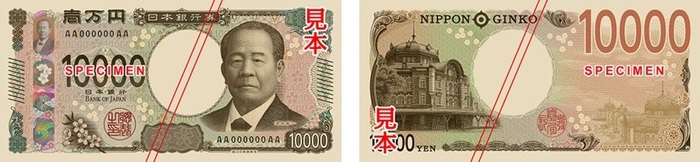
Japan is primarily a cash-based society, so understanding the currency is essential.
Banknotes (紙幣)
- ¥10,000 (ichiman-en) – the highest denomination; features Fukuzawa Yukichi (old) or Kitasato Shibasaburo (new design from 2024)
- ¥5,000 (gosen-en) – features Higuchi Ichiyo (old) or Tsuda Umeko (new)
- ¥1,000 (sen-en) – most common; features Natsume Soseki (old) or Kitasato Shibasaburo (new)
- ¥500 coin also exists as a high-value coin
Coins (硬貨)
Japan has 6 coin denominations: ¥1, ¥5, ¥10, ¥50, ¥100, ¥500.
- The ¥5 and ¥50 coins have holes in the center
- Small coins add up quickly — keep them organized in your wallet
Practical Exchange Tips
- USD rough estimate: ¥150 ≈ $1 USD (check current rates)
- Best exchange rates: Japan Post Bank ATMs, 7-Eleven ATMs (international cards accepted 24/7)
- Airport exchange desks have worse rates — exchange only what you need on arrival
- Keep small change ready: many smaller restaurants and shops prefer exact change
Tip for residents: Even if you use cashless payments regularly, always carry at least ¥2,000–¥5,000 in cash for situations where cards are not accepted.
⚠️ 免責事項: 本ページの情報は参考目的であり、最新の正確な情報は各行政窓口・公式サイトでご確認ください。